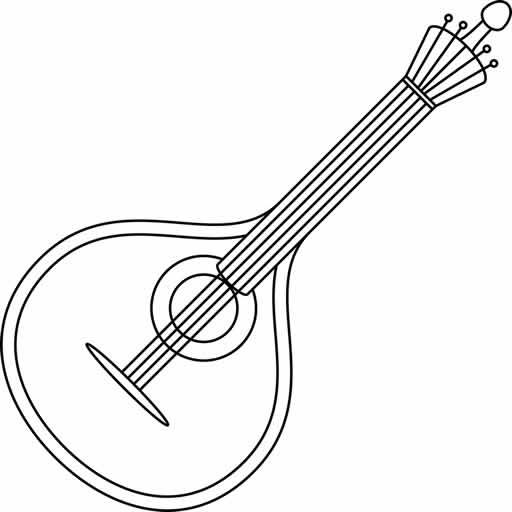
So you’ve got a new mandolin and would like to tune it. Here’s how ….
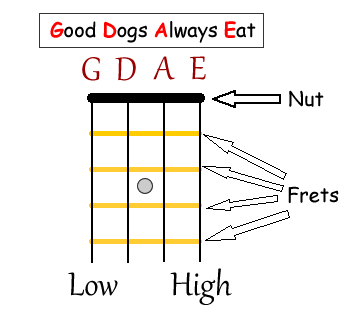
The mandolin has eight strings arranged in four pairs of two (a pair of strings is known as a course). The stings are tuned G D A E (G being the lowest tone). This can be remembered by the rhyme Good Dogs Always Eat. In order to ensure the strings are in tune you can use a chromatic tuner or tune by ear.
Tuning a mandolin using a clip on chromatic tuner.
This is my preferred method. A chromatic tuner that clips onto the headstock of the mandolin. These are very accurate and have the advantage that if you are playing with other instruments any other noise from them will not interfere with your tuning. Plenty are available on the internet or in music shops. Usually between £10 – £20. Note: One that is suitable for a violin and/or chromatic will be fine for a mandolin. One that is specific for a guitar only will not be suitable.
When you play a note on the mandolin a needle on the tuner will move. Usually it is when the needle is in the centre that the string is in tune. To tune the string up or down, turn the appropriate tuner peg. Which direction you turn the tuning peg will depend on whether the string is flat (too low) or sharp (too high). To tune up you usually turn the tuning peg away from you. To tune down you usually turn it towards you.
Note: You can get chromatic tuners that don’t clip on and use a microphone instead. They are not so good when you are tuning in a room full of other musicians as it will pick up the noise of them as well.
Tuning a mandolin using a chromatic tuner app
On Apple and Android there are various chromatic tuners you can download. Quite a few are free. These are great if you are not in a room with other instruments. If you are they will pick up noise from these instruments which will cause the needle on the tuner to go crazy!
You use the same method as described above for a clip on tuner, to tune the mandolin.
Tuning a mandolin to another instrument
To tune by ear you can use a pitch pipe or tune to another instrument like a piano ( go here to see what the notes are on piano) or accordion. Turn the tuning pegs until the two instruments sound in tune. Which direction you turn the tuning peg will depend on whether your strings are higher(sharp) or lower(flat) compared to the reference tone. One you have one course of strings in tune you can then tune the other strings to that course. For example if you have the second course (A strings) tuned then you would follow the following procedure to tune the rest of the strings.
Step 1: Play the 7th fret of the A strings. This gives the E note which should be the same as the E strings(1st course). Tune one of the E strings to the 7th fret of the A strings. Then tune the 2nd E string so both E strings are in unison.
Step 2: Play the 7th fret of the D strings. This gives an A note which should be the same as the A strings (2nd course). Tune one of the D strings so that when the 7th fret is played it is in tune with the A strings. Then tune the 2nd D string so both D strings are in unison.
Step 3: Play the 7th fret of the G strings. This gives a D note which should be the same as the D strings (3rd course). Tune one of the G strings so that when the 7th fret is played it is in tune with the D strings. Then tune the 2nd G string so both G strings are in unison.
 Scottish Mandolin